
“Stop and smell the digital roses.”

The Good, The Bad, and The Smelly
Video games engage and strengthen many senses. Research proves that interacting with virtual spaces improves our cognitive functions and reflexes. Since their inception, they have always stimulated three of our five senses: Sight, Sound, and, to an extent, Touch. But one particular sense is much closer to realization in the virtual world: Scent.
Making scent a part of the experience is nothing new in the world of entertainment. For all of us who grew up in theme parks, we remember those odd experimental simulation rides that pretend to be more grandiose than they actually are. Some notable mentions include Disney’s Soarin’ and Universal’s ET. On a side note, rest in peace, Shrek 4-D. But those only scratch the surface of the greater, weirder field of smelly entertainment.
There were a plethora of experimental scent interfaces in the 1900s, the most infamous of them being Smell-O-Vision. To make a long story short, two men named Hans Laube and Mike Todd Jr.— an inventor and film producer, respectively— released a movie called Scent of Vision in 1960.

It was a flop, with complaints ranging from hissing noises upon the release of the aromas to it not being adequately implemented for balcony viewers. Because the technology was so expensive, movie theaters opted to cut corners by using their air conditioners to waft the scents rather than the unit itself.
Smell-O-Vision may have been a failed experiment, but its concept has lived on, and recent advancements in XR tech prove that scent could still be applied to the larger scope of entertainment.
One lesser-known invention dates back to the ancient year of 2006. According to an academic paper by the IEEE Virtual Reality Conference, Japanese engineer Takamichi Nakamoto developed an interface that used solenoid valves to dynamically recreate scents.
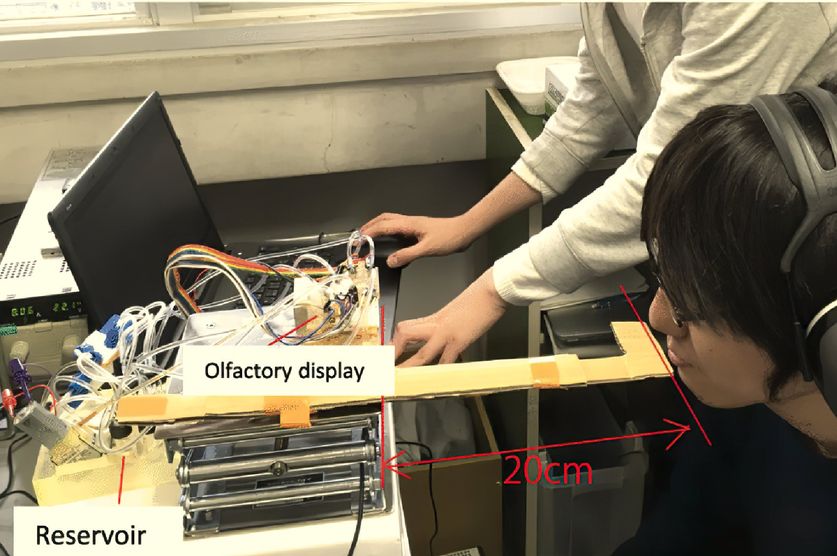
Initially, a movie was used for testing, but two years later, in 2008, a cooking game was implemented. Compared to the massive machination of yesteryear, it is considerably more ergonomic and intricate. However, it was still a big hunk of metal and wires that wouldn’t look good on anyone’s desk.
As technology advances, it shrinks and becomes more adaptable. Before we even reach the gaming market, we need an interface small enough to fit in our hands and light enough for a VR headset. Thankfully, the 2020s are here to present.
An Evolution Decades In The Making
Within the past few years, we have seen a massive surge in VR scent technology. In 2020, HapticSol released the Cilia interface; putting it bluntly, it is the most direct adaptation of Smell-O-Vision for the VR market.

The setup is pretty simple. Just mount it on a tripod adjacent to you and play; it then disperses scents in real-time and can be coded to the developers’ needs. To programmers who have access to 3D printers and want to partake, HapticSol offers DIY kits and sells a wearable version called Micro Cilia. It’s as rudimentary as it gets, but it provides a necessary glimpse into the growing world of VR Scent Spaces.
2022 alone saw a significant surge in these VR scent projects. In April, Arizona State University developed the intricate Smell Engine system.
One stand-out factor of this invention is its “Proximity-based Infrastructure.” As the person gets closer, scents are directly dispersed from an olfactometer into a mask attached to the VR visor or HMD and change in intensity depending on the distance. It’s a great attempt, but its lack of portability holds it back.
Later in October, the universities of Stockholm and Malmo in Sweden joined forces to develop a proof-of-concept wine-tasting simulator. Named Nosewise, it utilizes a 3D-printed olfactometer that attaches to a VR controller, giving it some extra interactivity and, most importantly, portability.
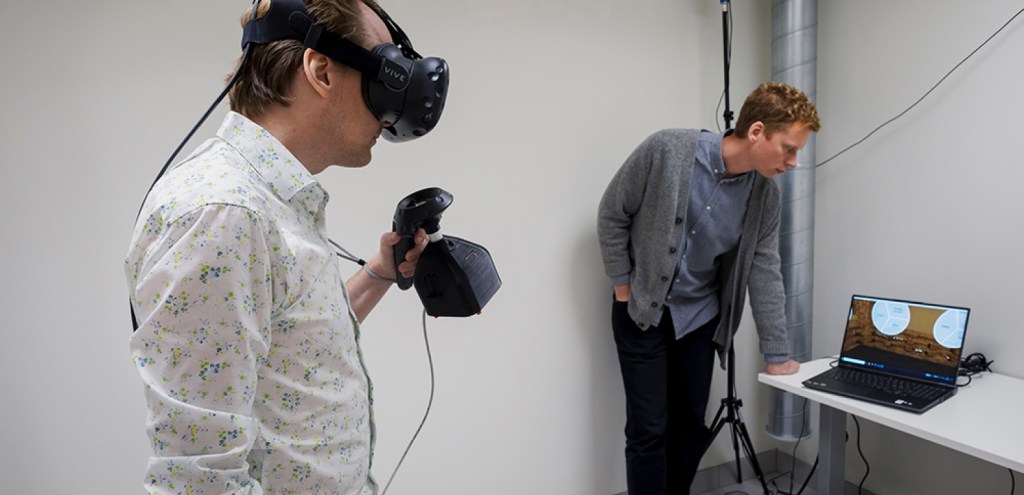

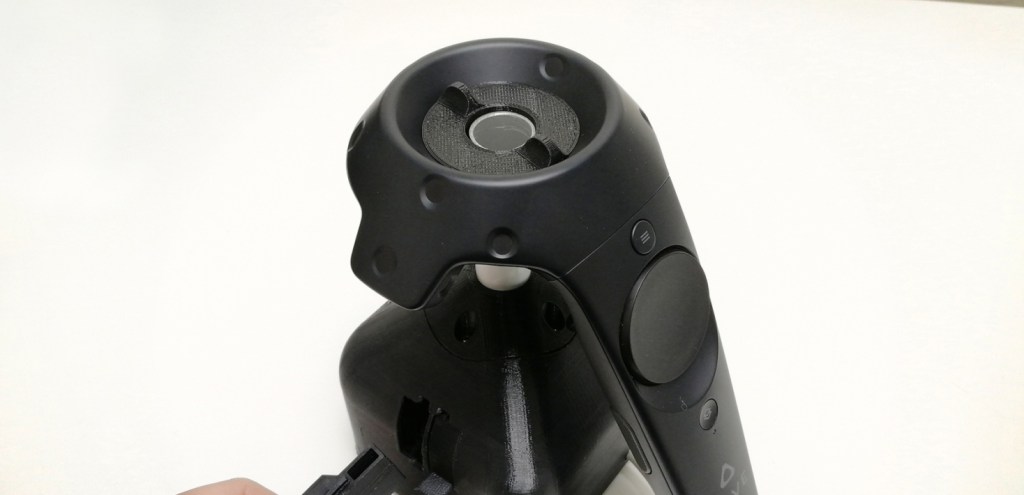
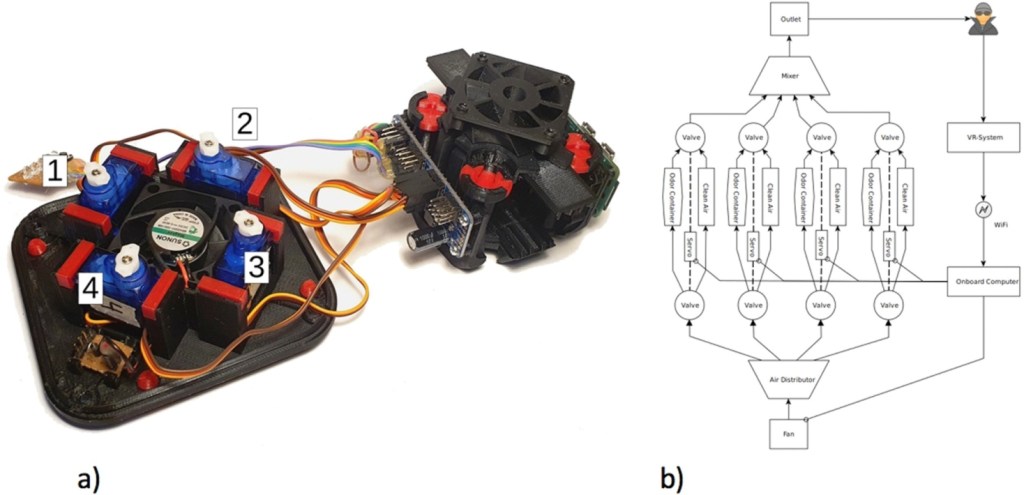
It also adds a much-needed touch of realism, as the game simulates the player bringing actual wine glasses to their nose. For those with untrained noses, the game features multiple difficulty options to help make their sense of smell stronger.
One of their hopes for making the technology open-source is for other developers to expand on the concept. They further add that the technology is applicable to all sorts of fields, the biggest of which is medicine. According to the project leader, Professor Jonas Olofsson:
“For those who, for example, lost their sense of smell after COVID-19 or for other reasons, the new technology can mean an opportunity to regain their sense of smell with the help of game-based training.”
Olofsson 2022, Stockholm University
What’s most surprising about these developments is that they were achieved independently. Just some bright minds in their labs carrying Smell-O-Vision’s legacy. Proving that the tech was VASTLY ahead of its time and wasn’t quite ready to face the world. This leads me to introduce the biggest player in the field, Sony, who, in 2021, patented scents for use in their games.
While Sony has yet to reveal what they’ve been working on, they have made a big push into the scent market with what they quote as the “Next-Generation Olfactive Machine.” With their patented Tensor Valve technology, the NOS-DX1000 can produce, using cartridges, 40 different smells. And its straightforward tablet interface allows it to switch between them easily and without risk of cross-contamination.

The potential for this device is tremendous, and Sony is, as we speak, showing off its capabilities to investors and the like. They disclose that, although it is not a medical device, its usability can be applied to many fields inside and outside health. With a gaming giant like Sony in the scene, it is possible that they will refine and implement this revolutionary technology for their gaming division. That is on a smaller, more consumer-friendly scale.
But if you want the most mobile option, look no further than OVR’s ION 3 system.
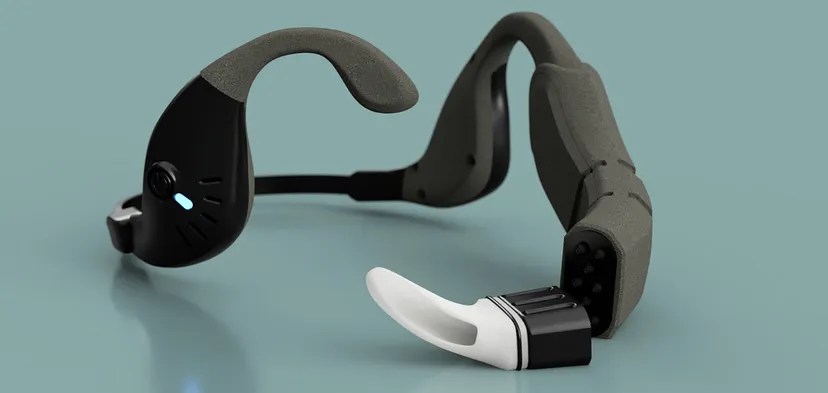
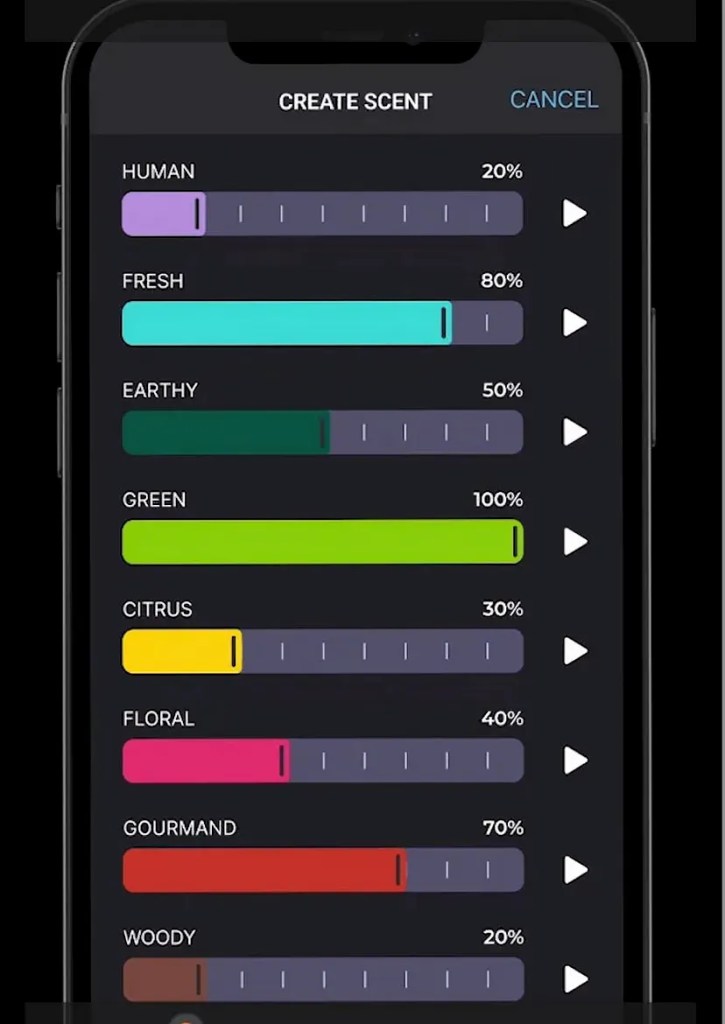
Bluetooth enabled, it can wirelessly pair with any phone, PC, VR, or AR interface. With their Scentware cartridge and OVR’s Scent Studio app, ION can create over 1000 digitally altered scents using eight primary aromas. Like the Smell Engine, it is compatible with both Unreal and Unity Engines. Their website states:
“OVR isn’t designed to exactly replicate the physical world but rather give you a whole new world of possibilities.“
OVR Technologies
There isn’t much information available for ION 3, but OVR plans to release a consumer version in 2023.
It’s strange yet fascinating that a failure like Smell-O-Vision could lead to all this. Now everybody wants to smell pixels, and it looks like a race to the finish to see who can perfect it first. What I hope for is that someone discovers a middle-ground option. The products I’ve mentioned thus far either use olfactometers or cartridges. You either plug it into a giant machine for more accuracy or refill the carts for portability. The tech needs a bit more fine-tuning before it can reach a stage of ease for not just standard consumers but also the gaming audience.
That said, there still remains one uncertain area… actual gameplay.
Can You Smell What the Future is Cooking?
Nosewise is a quiz/puzzle game, and it goes hand-in-hand with scent. Despite its simplicity, it is a complete game from start to finish. The question now is how complex can these sorts of games get?
I am not a game designer by any means, but scent is a nuanced sense—only being stimulated by molecules in the air. And unless you’re secretly the Avatar, you can’t play with air. If we’re talking purely about immersion, then the possibilities are ENDLESS.
Puzzle games aside, I can certainly visualize action, adventure, and horror games taking full advantage of our noses to enhance the experience. The wide-open fields, the revolting stalking monster, and the scorched earth. You wanna smell the flowers in “Open-World Game Number 5003?” Or how about the smoke and gunpowder in Call of Duty?
But these are just passive elements. What I desire more than immersion are active gameplay elements—things that move the game along and challenge the player. Let’s use the “Monster-Stalking” sim as an example.
You are a fast, strong, and vicious predator. Your objective is to hunt and eliminate the target. The target is weak, but smarter, and quite slippery. They can interact with their environment to hide and throw obstacles your way. The monster can't do much except use its physical advantages and senses. With a scent interface, the player can determine the target's specific smell and use it to track them down. Both the environment and target can interfere with the player's scent. Let's say the target is in a particularly smelly area; then, the interface would emulate that sensation. And if the target picked up a strong scent while evading the player then they would be debuffed.
That’s just one idea of what scent could do. It’s certainly nothing new, but the inclusion of scent might just be what these games need. It just needs to be nuanced enough to not be a gimmick. All that’s left are the statistics, and this is where things get cumbersome.
Scent has never been part of the gaming space, and it is unlikely to reach a universal level even with proper tests and implementation. The data isn’t there yet, so the concept hasn’t panned out enough for big developers to take a shot. If the Nintendo Wii U taught us anything, gaming interfaces die as fast as they live. Honestly, I’d say to just go for it. Video games are an ever-evolving science, and it would be a disservice to the industry if it wasn’t tried on a mass market level.
We have been engaging with them with the same three senses for years, and it’s time for a change. The medium will never reach its apex unless all of our senses are stimulated. It won’t be long until we start smelling pixels, and I personally hope that they smell like the case of a brand-new game… don’t pretend like you’ve never done it.
 Embrace the Pixels