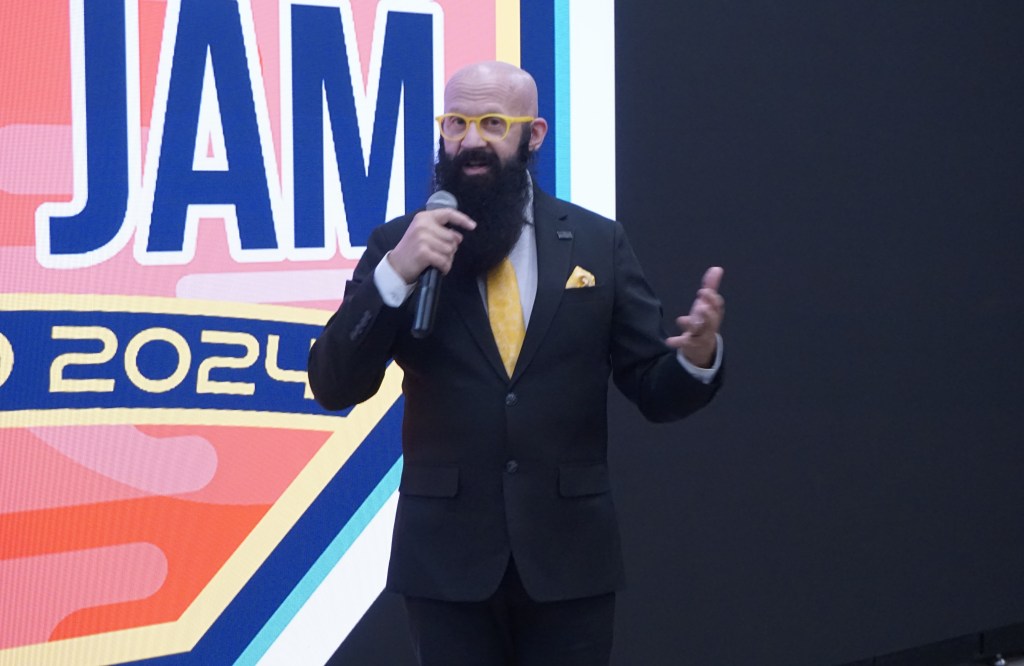
In this episode of Talking Pixels, I interview Robert S. Kats—a man with far too many labels under his name. We spoke about the importance of education, art, and gaming in the space industry. It’s rare that I get to speak to someone with his level of experience, so I’m amazed that the interview went as smoothly as it did. Enjoy!
What do you do professionally?
Katz:
So, I am the CEO and Chief Executive Officer of World Innovation Network. World Innovation Network is the consultancy I began when I started my career. I recently transformed it into a non-profit 501C3 and an international NGO so that I could take all the amazing experiences that I’ve had throughout my life to be able to serve my community and country and be able to empower the next generation of students, people, researchers, and explorers to follow in my footsteps and be able to have the similar type of impact and excitement on the world, themselves, and their families as I have. So, I’m focused exclusively on innovation and education in space.
How did you first get into space?
Katz:
I was fascinated with space even before I was born. Who’s not when you’re watching the moon landings, people explore new worlds and rocket ships? It’s like a fantasy world. It’s like cartoons coming true. And that’s something we talk about: how art imitates life and how life imitates art. But when you see it, you say, “I want to be a part of that; I want to contribute to that.” I know that I’m probably not up to being an astronaut, but I could help the astronauts get to where they need to be, so I studied and read everything I could and made all kinds of models. Eventually, when I was a freshman in college, I got an internship working on the Hubble Space Telescope. From there, my trajectory was all space all the time.
How was working on the Hubble Telescope like?
Katz:
So, at the surface, it’s like, oh wow, it’s amazing and so cool. It’s all that, but when you drill down into the details, it can be really tedious, just like any job. If you think about a Corvette, like, “Oh, it’s so amazing,” but you might spend years examining a brake pad and learning how the brake pad works, and you don’t necessarily see how that fits into the whole picture unless you do some research outside your job. So, although I was working on a very, very, very specific but essential part, I didn’t truly understand the importance of it, and it’s sometimes not obvious to the individual how they fit into the entire group, the patchwork and how everybody needs to work together to make the whole happen. That’s why we must communicate with the others we work with to have that perspective because, especially for space, it takes a long time. So, you may not be able to see the end, but you do need to begin with the end in mind, as I always say. That’s Stephen Covey, one of his seven principles.
Gio:
Start with the end and work towards the start.
Katz:
Yes, because if you don’t know where you’re going, you don’t even know where to start. So, in everything we do, especially jobs that young folks have nowadays, sometimes they don’t have that perspective because all they see is a menial task. But the menial tasks are really important. When I teach Emergency Management as a firefighter, paramedic, or emergency manager, I tell people that garbage collectors save more people than doctors. How many people does a doctor save in a day? If he works in the ER, he might save one or two—
Gio:
If insurance doesn’t get in the way.
Katz:
Yeah, maybe that, but on the floor, they’re kind of just managing the situation and don’t have a high impact. For the garbage collector, if that garbage isn’t collected, hundreds, if not millions, of people may die. Imagine if the people who fix your roads didn’t maintain that road and you had a medical emergency or a fire. All those millions of dollars of fire trucks and hundreds of highly trained firefighters couldn’t get to your house or business if that road crew didn’t maintain that road, so we all have to work together as a part of this patchwork. To keep our families, communities, countries, and companies moving forward.
Gio:
I understand that garbage men make a lot of money, surprisingly. Granted, I’ve only heard; I’m not sure what the specific number is.
Katz:
Most people don’t give them the respect they deserve and understand the importance of their job. And this is one example.
What brings you here to the game jam?
Katz:
Oh, that’s a great question. So, gaming is critical to taking our ideas, technologies, programs, projects, and communities to the next level. Some people, well, why gaming? Because it’s cool and it’s fun. No, that’s part of it. Gaming is like writing a novel. Why are novelists so important to what we do? What do you think?
Gio:
They innovate ideas.
Katz:
That’s exactly right. But why do they innovate new ideas?
Gio:
It’s part of the artistic process. Artists want to see their creations come to life.
Katz:
OK, but why? What makes what allows that to be part of that process? What allows them to have that innovation?
Gio:
I actually don’t know.
Katz:
Because they’re unconstrained by current laws of physics, the theories, or the norms, an engineer would never be able to design and innovate as well as a writer, an artist, or even a game developer. Because they’re always thinking about the constraints of what it would take to implement something, whether it’s physical, financial, or logistical, that even if you pretend to be an engineer, you really can’t because those biases in your brain are just so inherent it doesn’t give you the freedom to unlock and tap in what the art of the possible is, but artists, musicians, or game developers doesn’t have those constraints. They can push the limits; once they establish them, the engineer has something to shoot for. Therefore, the artistic, humanistic, and humanities communities must work together with the technical science community to innovate and obtain what’s possible.
Does that make sense?
Gio:
It does. As someone who has played video games their whole life, watches movies, and reads books, first, there’s the idea, and then there’s making it a reality. Like on YouTube, how people make real functioning lightsabers in their garage. Of course, without Star Wars, lightsabers wouldn’t be a thing.
Katz:
They wouldn’t be creating the technology unless they were inspired by what they saw.
Gio:
Exactly.
Katz:
In the arts, right? Life imitating art.
Gio:
The same goes for many famous science-fiction movies, like 2001 A Space Odyssey.
Katz:
Of course, people don’t even know. They have no idea how much that movie foreshadowed, even 20,000 Leagues Under the Sea or Buck Rogers, all these really old works we look at today and go, “Yeah, whatever.” But you have to realize that was way before we had any of this technology. That was considered crazy at the time.
What are you hoping to get out of this small-scale event? What are you hoping to see?
Katz:
I’ve already seen what I was hoping to see: amazing minds doing amazing things, pushing the limits of what’s possible. It’s not all just about the end product; it’s also about the process. It’s about what you’re coming up with and how you’re working together to do it, which is in many ways more important than the result. It creates the framework of interpersonal communication, collaboration, and team-building skills that create force multipliers in what we do rather than just everybody doing their own thing. Many people these days don’t even know how to communicate with each other, so having all those levels of collaboration with people is truly amazing.
 Embrace the Pixels